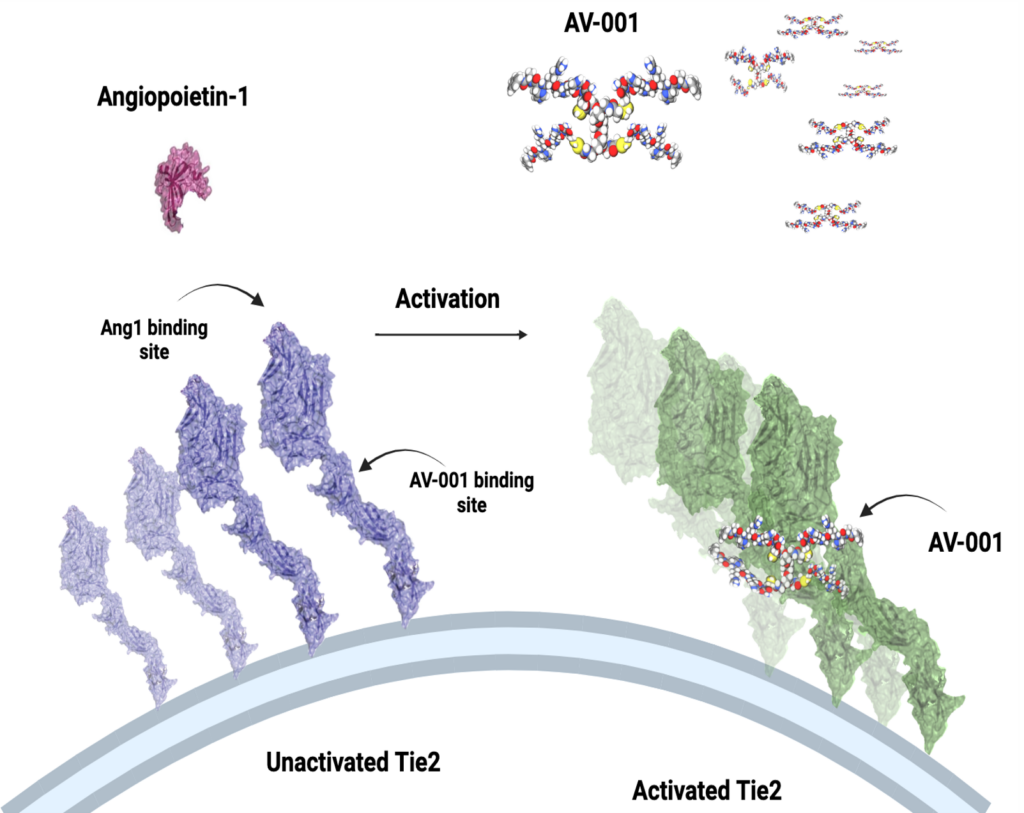
The Tie2 receptor is expressed on the surface of endothelial cells. Its’ two main growth factors, Angiopoietin 1 and Angiopoietin 2, propagate anti-inflammatory or pro‑inflammatory responses respectively through the Tie2 receptor and it is the balance between Angiopoietin-1/Angiopoietin-2 that is critical in defining vascular endothelial stability.
Vasomune’s lead compound, Pegevongitide (AV‑001), like its predecessor Vasculotide, is a fully synthetic Angiopoietin 1 mimetic optimized to counter vascular leakage and inflammation.
The overwhelming majority of pharmaceutical efforts aimed at modulating the Tie2 pathway do so by inhibiting Angiopoietin 2. However, protein therapeutics designed to inhibit a single factor have historically been fraught with issues of ‘biological compensation’. Preclinical studies show that activation of the Tie2 receptor with Pegevongitide (AV‑001) provide robust vessel-stabilizing properties following exposure to a diverse range of inflammatory mediators.
Consistent with the breadth of protection, administration of Pegevongitide (AV‑001) has proven therapeutic benefit in several different in vivo disease models marked by vascular dysfunction, including acute lung injury, hemorrhagic shock, acute kidney injury, and wound healing.
Vasomune Therapeutics has selected pathogen-induced pneumonia and Acute Respiratory Distress Syndrome (ARDS) as its lead indication based on published results from in vivo studies of pneumonia and multiple strains of influenza. Results from these studies of Pegevongitide (AV-001) or its predecessor analog Vasculotide demonstrated significantly improved survival following exposure to lethal doses of influenza. In a murine model of Streptococcus pneumoniae, Vasculotide administration significantly restored lung endothelial barrier function and reduced lung hyperpermeability. Importantly, the systemic inflammatory response was unaffected.
Based on these promising preclinical and Phase 1 clinical results, Pegevongitide (AV‑001) was awarded Fast Track Designation by the FDA in 2024.